Guide
The AI Month Close: How Finance Teams Reconcile LLM Spend Like Any Other COGS Line
Every other line on the income statement gets closed. Cloud infrastructure is closed monthly through tagging and showback. Salaries are closed through the payroll subledger. Software subscriptions are closed through the AP module. Even cloud egress - historically the unloved sibling of cost lines - has a clean monthly close because AWS, GCP, and Azure publish detailed billing files that map cleanly to cost centers.
Then there is AI spend. For most companies in 2026, the AI close looks like this: someone in finance opens the OpenAI invoice, copies the total into a journal entry, and books it to a single GL account called "AI services" or "Software - AI." That is not a close. That is a transcription.
The reason this is acceptable for now is that AI spend is still small relative to revenue at most companies. The reason it is about to become unacceptable is that AI spend is growing faster than any other cost line, and once it crosses 5–10% of revenue at scale it becomes a gross margin question rather than an opex question. At that point finance needs the same level of controls, allocation completeness, and audit trail it has on every other COGS line. That is what the AI month close is for.
This guide describes what closing the books on AI spend actually means, the four blockers that make it hard today, the four-step process to do it well, and the controls auditors are starting to ask about.
What "closing the books" on AI spend means
A month close on any cost line answers four questions:
- Completeness. Has every dollar of spend in the period been recognized?
- Allocation. Has every dollar been assigned to the cost center, customer, or product line that caused it?
- Accuracy. Are the dollar amounts and units (tokens, requests) reconciled to source records?
- Cutoff. Are we recognizing spend in the period it was incurred, not the period it was invoiced?
For a SaaS subscription, this is trivial. The AP module handles all four. For cloud infrastructure, FinOps tools have spent a decade making it merely tedious. For AI spend in 2026, none of the four is solved out of the box.
Provider invoices give you a single number for completeness - the total - but say nothing about allocation, cannot be reconciled at the request level without separate logs, and use cutoff conventions (UTC midnight, billing period boundaries) that may not match your fiscal calendar. Closing AI spend properly means rebuilding the four answers from raw request-level data.
The four blockers
If you have tried to close AI spend cleanly and it felt impossible, here is why.
1. Provider invoices are aggregated and post-hoc
OpenAI bills you a total. So does Anthropic. So does Google. The invoice arrives 1–5 business days into the following month, often with a CSV breakdown by model but rarely by anything finance can use. There is no customer dimension. There is no feature dimension. There is no agent or workflow dimension. There is just a model, a token count, and a price.
You cannot allocate from the invoice. The invoice is a single number that has to be decomposed by data you collected at request time - and if you did not collect it then, no amount of finance work will recover it.
2. The data lives in engineering tools
Token counts, model identifiers, and request metadata typically live in observability tools (Helicone, Langfuse, Langsmith) or in application logs that engineering owns. These tools were built to debug latency and quality, not to close books. They rarely have a customer dimension, almost never have a cost center dimension, and almost always lack an audit trail finance can rely on. "Engineering says the number is X" is not a control finance can sign on. That distinction is worth understanding before you swap one observability tool for another, and it is worked through in Helicone alternatives for teams that need financial governance.
3. There is no allocation completeness check
In cloud cost management, "untagged spend" is a known quantity that gets reviewed every month. AWS Cost Explorer literally has a category called "Untagged" and FinOps teams chase it down to under 5% before close.
For AI spend, most companies do not even know what their untagged percentage is. Requests come in, get processed, and get billed. If the engineering team forgot to attach a customer header on a particular code path, that spend is silently uncategorized and finance has no way to detect it short of a manual reconciliation between request volume and revenue cohorts.
4. There is no journal-entry primitive
Even if you have the data, there is no clean way to post it. Most teams end up with a single monthly JE that books AI spend to a single GL account. Allocation by customer, feature, or cost center does not exist on the books - it lives in a spreadsheet that gets emailed around. That breaks every downstream process: gross margin per customer, contribution margin per feature, board reporting, and any audit attestation that looks for documented allocation methodology.
The four-step AI month close
The pattern that solves this looks like the cloud-cost close pattern, adapted for AI's request-level reality. Four steps, run on a fixed cadence in the first business week of each month. Each step has a gate, and a failed gate sends work backwards into instrumentation rather than forwards into the close.
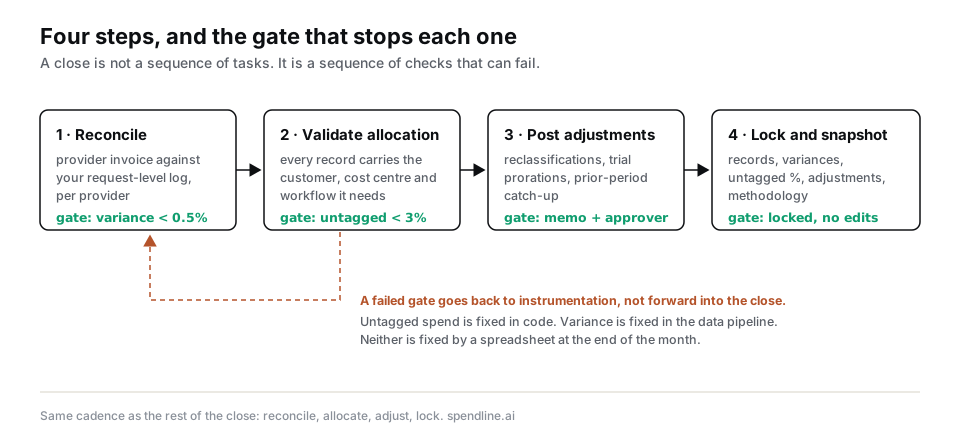
Step 1: Reconcile
Pull every provider invoice for the period. For each provider, reconcile invoice total to your request-level cost record:
| Source | Total spend | Difference |
|---|---|---|
| OpenAI invoice | $42,180.16 | - |
| Internal cost log | $42,156.40 | $23.76 (0.06%) |
| Anthropic invoice | $18,300.00 | - |
| Internal cost log | $18,290.50 | $9.50 (0.05%) |
Acceptable variance is typically under 0.5%. Variance over 1% indicates a data collection problem (dropped requests, clock skew, model pricing drift) that needs investigation before you can close.
The reconciliation step is non-negotiable. Without it, the rest of the close is unverifiable. This is the AI equivalent of bank reconciliation: you cannot close cash without it, and you should not close AI spend without it either. The mechanics of that comparison (pulling each provider's cost API, and the two separate bridges you need to explain a gap) are worked through in how to reconcile OpenAI and Anthropic invoices.
Step 2: Validate allocation completeness
For every cost record, confirm it has the dimensions required for allocation:
- Customer dimension - required if you report gross margin per customer
- Cost center dimension - required if you allocate to teams or products
- Workflow dimension - required if you analyze unit economics by feature
Then compute the untagged percentage:
untagged % = (cost of records missing required dimension) / (total cost)
A healthy AI close has untagged spend under 3%. Above 5%, you have an instrumentation gap that needs fixing in code, not in finance. The untagged percentage is the AI version of the FinOps Foundation's allocation completeness KPI - and it is the single best leading indicator of how clean your gross margin reporting will be.
Step 3: Post adjustments
Some allocation issues cannot be fixed at the source - they have to be adjusted in finance. Common cases:
- Reclassification. Spend tagged to "experiments" that turned out to be production traffic, and needs to be moved from R&D to COGS. (See AI COGS vs R&D classification.)
- Prorations. Free-trial customers whose spend should be allocated to a separate "trial COGS" account, not loaded onto paying customers.
- Catch-up. Spend incurred in a prior period but only invoiced this month due to provider billing lag.
Each adjustment needs a memo, an approver, and a reversing entry where appropriate. Treat them like any other journal entry: documented, reviewed, and stored in a way that survives an audit.
Step 4: Lock and snapshot
Once reconciliation, allocation, and adjustments are complete, the period is locked. No further changes can be made to historical cost records without a documented re-open. A snapshot of the closed period is preserved, including:
- The full set of cost records
- The reconciliation differences (and explanations for any over the variance threshold)
- The untagged percentage
- The adjustment journal with memos
- The allocation methodology applied (so the close is reproducible if questioned)
This is what auditors mean when they ask "is this number final?" It is also what your VP Finance means when she asks for the gross margin number for the board deck and needs to be sure it will not change underneath her after she hits send.
Mapping to a standard close calendar
For a company with a T+5 close timeline (books closed by the fifth business day of the following month), the AI close fits like this:
| Day | AI close activity | Standard close activity |
|---|---|---|
| BD-1 (last day of month) | Cutoff freeze on cost records | Inventory cutoff, AR aging |
| BD+1 | Receive provider invoices, begin reconciliation | AP cutoff, payroll close |
| BD+2 | Reconcile complete, allocation completeness check | Bank reconciliation, accruals |
| BD+3 | Post AI adjustments | Revenue cutoff, deferred revenue |
| BD+4 | Lock AI period, generate snapshot | Pre-close review |
| BD+5 | AI gross margin reporting integrated into management reports | Books closed |
The point is not that the calendar is rigid. The point is that AI close is now part of the core close, on the same cadence, with the same level of formality, instead of being a side process that finance does on a Wednesday afternoon when it can find time.
What auditors are starting to ask
Public-company audits of AI spend are still rare in 2026 because most of the affected companies are private. That will change. The questions auditors will ask have already begun appearing in due-diligence checklists for late-stage rounds and acquisitions. They are:
- What is your allocation methodology for AI spend, and is it documented?
- What percentage of AI spend is untagged or unallocated, and what is the trend?
- How do you reconcile provider invoices to internal cost records, and what variance is considered acceptable?
- What controls exist to prevent retroactive changes to closed-period cost records?
- How is COGS-classified AI spend distinguished from R&D-classified AI spend? (See AI COGS vs R&D.)
If your AI close cannot answer all five questions, your AI gross margin number is not a number your CFO should be putting in a board deck. It is an estimate.
Why this is becoming CFO-mandated
Three forces are converging in 2026:
Investor scrutiny. Late-stage rounds and especially IPO-track companies are being asked for AI gross margin breakdowns by customer cohort. The teams that have a clean close can produce them in an hour. The teams that do not are spending two weeks and producing numbers they cannot defend.
Audit readiness. With AI spend running at a material share of revenue at AI-native companies (ICONIQ's 2025 AI report put the median around 30% with a heavy tail well above that), AI lands squarely in the COGS bucket for gross margin reporting. Once it is COGS, it is auditable, and auditors will want documented controls.
Operating leverage. Companies that close AI cleanly can identify unprofitable customers, unprofitable features, and runaway experiments within days, not quarters. That is a real operating advantage. Companies that cannot close AI properly do not even know which customers to fire.
Our expectation, offered as judgment rather than fact: the AI month close moves from "nice to have" to "control deficiency if absent" inside of about 18 months. The teams that build the muscle now will close in days. The teams that wait will spend the next two years rebuilding journal entries from logs.
How Spendline does this
Spendline is built around the four steps above. Every proxied call is priced and written to an append-only ledger with the tenant, customer, workflow and a server-controlled timestamp deciding which month it lands in, so the caller's clock never decides the period. At month end the period moves through open, ready, closed and reconciled; a closed month is immutable, late-arriving calls for it are rejected, and corrections are posted as new adjustment rows rather than edits, each recorded in an audit log with the actor who made it.
The reconciliation compares the ledger total against the provider invoice and shows the variance, which is the control auditors are starting to ask for. If you currently close AI spend from a provider CSV, this replaces the CSV with a ledger that already agrees to it. Details are on the integration page.
FAQ
What is an AI month close? The monthly process of turning raw AI spend into a closed, auditable cost line: reconcile provider invoices against your own request-level records, confirm every dollar is allocated, post documented adjustments, and lock the period.
Why can't we just book the invoice total? A total answers completeness only. It says nothing about allocation, cannot be reconciled at the request level, and uses billing cutoffs that may not match your fiscal calendar.
What variance is acceptable? Under about 0.5% in our experience. Above 1% usually means dropped requests, clock skew, stale rate tables, or unpriced token types, and should be investigated before closing.
What is untagged spend, and what is healthy? Cost that reached a provider without the dimensions needed to allocate it. Under 3% is a healthy target; above 5% is an instrumentation gap to fix in code, not in finance.
What do auditors ask? Whether the allocation methodology is documented, the untagged percentage and its trend, how invoices reconcile to internal records and at what tolerance, what prevents retroactive edits to closed periods, and how COGS is distinguished from R&D.
Sources and method
Written from building Spendline's AI spend governance proxy and its close workflow, combined with public sources: the FinOps Foundation's allocation and cost-allocation guidance for the completeness KPI this adapts; FOCUS for the billing-data schema now covering tokens (see our FOCUS 1.4 guide); ICONIQ's 2025 AI report for AI spend as a share of revenue. The variance and untagged thresholds (0.5%, 3%) are our operating recommendations calibrated against standard cloud-cost practice, not published standards, and the 18-month prediction is judgment. Illustrative reconciliation figures are examples, not customer data. Last updated: August 2026.
Want to know which customers were behind last month's AI bill before finance asks? Book a free 30-minute call. No integration is needed: we go through where your AI cost lands by customer and workflow, and how you would find the accounts that cost more than they pay. If the call turns up a real gap, we offer a free 60-day pilot on your own traffic. Book the 30-minute call
Not ready to talk? Take the 5-minute assessment instead.