Guide
FOCUS 1.4 Made Token Spend Official. That's Not the Same as Making It Legible.
FOCUS 1.4 made token spend official. That's not the same as making it legible.
On 4 June 2026 the FOCUS Steering Committee ratified FOCUS 1.4: two new datasets, 47 new columns, no breaking changes, and the first version of the spec to treat token-based spend as a first-class billing object. Days later at FinOps X, the Linux Foundation announced its intent to launch the Tokenomics Foundation to govern this area, and formally launched it on 4 August 2026 with founding members including JPMorganChase, IBM, Oracle, SAP, ServiceNow, Accenture, and BNY, alongside a long list of cost-tooling vendors.
The press covered the foundation. The spec itself is the part that changes how you buy software.
What FOCUS 1.4 actually added
FOCUS - the FinOps Open Cost and Usage Specification - is a schema that lets organizations normalize billing data across cloud providers. Before it, every provider sent cost data in a different format. Finance teams built custom pipelines to reconcile AWS, Azure, and GCP into something a CFO could sign off on.
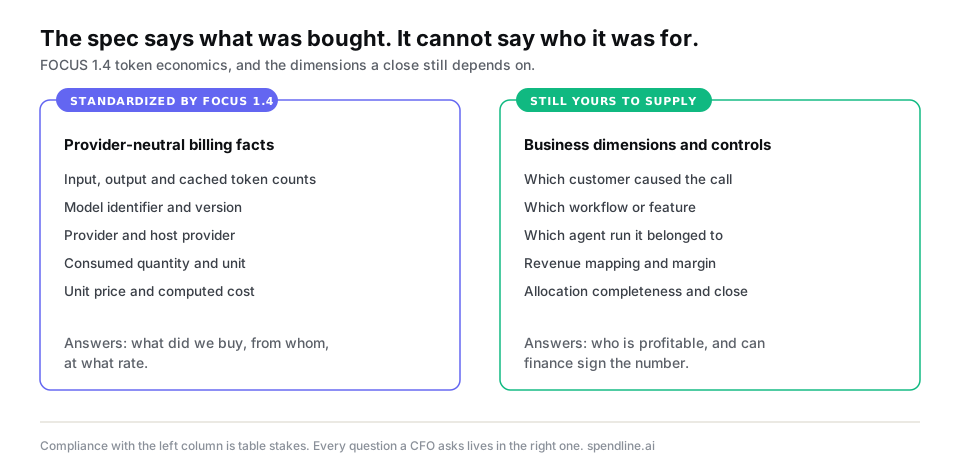
FOCUS 1.4 extends this to tokens. The additions describe consumed quantity and unit, the host provider behind a service, and separate counts for input, output, and cached tokens, alongside model identity and pricing fields. In plain terms: a provider-neutral way to say what was consumed, by which model, at what rate.
This is the first time LLM spend has a defined place in the FinOps spec. Once something is in the spec, it becomes a procurement requirement. Organizations that have standardized on FOCUS for their cloud bills will expect the same from AI spend vendors. Vendors that cannot produce compliant output will lose RFPs to vendors that can.
The gap the spec doesn't close
FOCUS 1.4 tells you which columns to populate. It doesn't tell you how to populate them in a way your CFO can work with.
A token event happens at the API layer. The model receives a prompt, returns a completion, and the provider logs the tokens consumed. What that log doesn't tell you is which customer triggered the call, which agent or workflow was responsible, or how the cost maps to a revenue line in your P&L.
FOCUS compliance means you can produce structured data with the right column names. FOCUS-useful output means that data is attributed at the business unit level and can be reconciled against your customer invoices at month close. Most of what's being sold as "AI cost visibility" today stops at the first one. You can see aggregate token spend broken down by model. You still can't answer the CFO's question: which customers are costing us money, and is gross margin per customer holding as we scale AI usage?
Why the founding members matter
JPMorganChase and IBM did not join the Tokenomics Foundation to normalize token usage for engineering dashboards. Organizations of that size want margin analytics, audit trails, and a clear view of what each product line spends on AI per customer per billing period.
The membership list is worth reading closely for a second reason: alongside the enterprises sit the cost-tooling vendors (Vantage, Finout, Revenium, Flexera, Kion, DoiT and others). Buyers and sellers are shaping the same standard at the same table, which is usually how a nice-to-have becomes an RFP line.
Our read, stated as a prediction rather than a fact: within roughly 12 to 18 months a FOCUS gap in a vendor evaluation becomes disqualifying rather than a roadmap question, because the enterprises writing the checks are the ones who just committed to the standard. That timing is a judgment call and reasonable people will put it earlier or later.
What a control plane does that a dashboard doesn't
Most tools in this space were built for engineers. They track tokens, report spend, and surface anomalies after the fact. That's useful, but it stops well short of what a finance team needs at close.
A control plane sits in the request path. It enforces budget rules before the provider call is made, attributes cost to a customer or agent at call time rather than reconciliation time, and produces output a finance team can close the books with, not a CSV that someone has to clean up in a spreadsheet. (Where each layer of the stack stops is mapped in gateway vs observability vs governance.)
FOCUS 1.4 compliance is table stakes for any serious vendor in this space. The question worth asking is what happens above it: who handles the attribution hierarchy, the override approvals, the immutable audit log, and the month-close reconciliation a CFO can sign off on.
Three questions for your next vendor evaluation
- Can you produce FOCUS-compliant output, column by column, for every LLM call?
- Can you attribute that spend to a specific customer, agent, or cost center at call time, before the invoice arrives? (The mechanics are in how to track LLM costs per customer.)
- Can your output feed directly into our month-close process, or does finance need to reconcile it manually?
If the answer to any of those is "we're working on it," you have an observability tool. That distinction matters when your AI bill is a line item your CFO has to explain to the board.
How Spendline does this
Spendline is a control plane of the kind this article distinguishes from a dashboard. Every call routed through it is priced at the moment it happens and attributed to a customer, agent and cost centre via request headers, so the token spend that FOCUS 1.4 makes a billing object arrives already legible to finance. Budgets are enforced before the provider is called, corrections are new ledger rows rather than edits, and the month-close workflow reconciles the ledger to the provider invoice and locks the period.
For the three vendor questions above: enforcement happens in the request path, attribution is per request, and closed months are immutable. Setup is a base URL change; see the integration page.
FAQ
What is FOCUS 1.4? The FinOps Open Cost and Usage Specification, version 1.4, ratified 4 June 2026. It normalizes billing data across providers and is the first release to treat token spend as a first-class billing object: two new datasets, 47 new columns, no breaking changes for existing implementations.
Which token columns did it add? Consumed quantity and unit, the host provider name, and separate input, output, and cached token counts, alongside model identity and pricing fields.
Does FOCUS 1.4 give finance per-customer AI costs? No. It standardizes the shape of token billing data, not its business dimensions. Nothing in the spec identifies which customer, workflow, or agent caused a call. That has to be captured in your own request path.
What is the Tokenomics Foundation? A Linux Foundation program for standards and best practices in AI economics. Intent to launch was announced at FinOps X in June 2026; it formally launched on 4 August 2026 with founding members including JPMorganChase, IBM, Oracle, SAP, ServiceNow, Accenture, and BNY, plus a set of cost-tooling vendors.
Do we need to be FOCUS compliant? If you sell AI cost tooling to enterprises, it is becoming table stakes. If you are the buyer, treat it as a floor and ask what the vendor does above the spec.
Sources and method
Spec details from the FinOps Foundation's FOCUS specification and its FOCUS 1.4 release coverage; foundation timeline and founding-member list from the Linux Foundation's own announcements, the intent to launch and the launch release of 4 August 2026. The 12-to-18-month procurement prediction is our judgment, labeled as such in the text, not a published forecast. Written from building Spendline's AI spend governance proxy. Last updated: August 2026.
Correction, August 2026: an earlier version of this guide named Booking.com and Salesforce among the founding supporters and dated the foundation to June. Neither company appears on the published founding-member list, and the formal launch was 4 August 2026. Both points are corrected above.
Exporting token spend and still unable to split it by customer? Book a free 30-minute call. No integration is needed: we go through where your AI cost lands by customer and workflow, and how you would find the accounts that cost more than they pay. If the call turns up a real gap, we offer a free 60-day pilot on your own traffic. Book the 30-minute call
Not ready to talk? Take the 5-minute assessment instead.