Guide
AI Gateway, LLM Observability, or AI Spend Governance: What Each Layer Actually Does
If you are responsible for AI cost at your company in 2026, you are probably looking at a tool category that did not exist three years ago and is already fragmented into at least three sub-categories that get conflated in nearly every blog post and pitch deck.
There is the AI gateway category - LiteLLM, Portkey, OpenRouter - which makes it easier to call multiple providers behind a unified API. There is the LLM observability category - Helicone, Langfuse, Langsmith, OpenLLMetry - which tells engineering teams what is happening inside their LLM calls. And there is the emerging AI spend governance category - which puts the finance team in control of allocation, budgets, gross margin, and the close.
These categories are not competitors. They are layers in a stack. But because they all touch LLM API traffic and all claim "cost visibility" in their marketing, buyers routinely conclude they need to pick one - and end up with a tool that solves a different problem than the one they had.
This guide is the honest map. What each layer does, what each layer does not do, when you adopt which, and how they stack together. We sell software in the third category and have no interest in pretending the first two do not exist; we work better when they are present.
The three layers, in one sentence each
AI gateway: makes it easier for engineering to call multiple LLM providers from one place, with retries, fallbacks, and key management.
LLM observability: gives engineering visibility into what each LLM call is doing - latency, errors, prompts, completions, traces, evals.
AI spend governance: gives finance control over how AI spend is allocated, budgeted, and reconciled across customers, features, and cost centers.
The verbs matter. Gateway makes it easier. Observability gives visibility. Governance gives control. Each verb maps to a different team, a different decision, and a different product surface.
The structural difference is simpler than the marketing suggests: a layer that sits on the request path can refuse a call before money is spent, and a layer that sits beside it can only explain the call afterwards.
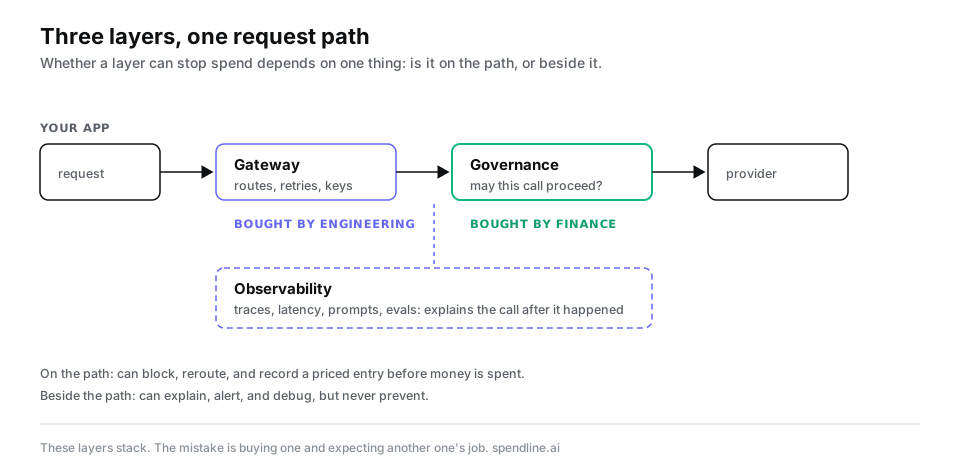
What an AI gateway does
A gateway is engineering infrastructure. It sits between your application and one or more LLM providers and abstracts away the differences. The shape of the value:
- Unified API: call OpenAI, Anthropic, Google, Mistral, xAI through one SDK or one base URL
- Retries and fallbacks: if the primary provider is down or rate-limited, route to a backup automatically
- Key management: keep provider keys in one place, rotate them, scope them per environment
- Caching: deduplicate identical prompts to save tokens
- Some routing logic: cheap-model-first, premium-model-on-fallback, regional routing
The buyer is engineering. The benefit is operational simplicity and reduced vendor lock-in. LiteLLM, Portkey, OpenRouter, AWS Bedrock, Cloudflare AI Gateway are all in this category. They differ in deployment model (self-hosted vs. SaaS), routing sophistication, and ergonomics, but they are solving the same problem.
What a gateway is not built to do:
- Per-customer cost attribution at finance grade. Most gateways log call volume but treat the customer dimension as an optional tag the engineer may or may not include. There is no allocation completeness check, no enforcement.
- Hierarchical budgets enforced before the provider call. Some gateways have rate limits. Rate limits are not budgets. A budget is a dollar amount with an enforcement rule that fires when it is exceeded; a rate limit is a request-per-second cap.
- Gross margin reporting. The gateway has cost data and request data. It does not have your revenue data, your customer-to-account mapping, or your COGS classification policy.
If you have a gateway, your engineering team is happy and your provider redundancy is solid. Your CFO still cannot answer "which customer is profitable after AI cost?"
What LLM observability does
Observability is engineering tooling for understanding what is happening inside LLM calls. The value:
- Trace view: see the full path of a request through prompts, tools, sub-agents, retries
- Latency and error tracking: which models are slow, which calls fail, where the time goes
- Prompt and completion logging: the actual text in and out, so you can debug quality issues
- Eval framework: score model outputs against test cases, catch regressions
- Token-level metrics: input/output tokens, cost in dollars, attached to each call
- Some user/session tracking: who made the call, in which session
The buyer is engineering - typically the team building the AI feature, not the platform team. Helicone, Langfuse, Langsmith, Arize, LangWatch, Phoenix, OpenLLMetry are in this category, with significant variation in self-hosted vs. cloud, open-source vs. commercial, and depth of evaluation tooling.
What observability is not built to do:
- Allocation by business dimension. Observability tools track "user" and "session" - but "user" usually means the end-user of your product, not the paying customer whose contract attributes the cost. If a single paying customer has 50 users, observability does not roll those up to the customer level by default.
- Budget enforcement. Observability tells you that you spent $40K last month. It does not stop you from spending $80K next month if the workload changes.
- Period close. Observability is event-stream-oriented; finance needs period-locked snapshots with reconciliation against provider invoices, an adjustment ledger, and an audit trail. (See The AI month close for what this involves.)
- COGS classification policy. Observability stores tokens and dollars. The decision of whether a particular workload is COGS or R&D is made elsewhere. (See AI COGS vs R&D.)
If you have observability, your engineering team can debug AI quality issues and your platform team can see latency trends. Your finance team still does not have a number they can sign off on.
What AI spend governance does
This is the newest category, and the one most often conflated with the other two. Governance is finance and operations tooling for controlling how AI spend is allocated, budgeted, and reconciled. The value:
- Per-customer cost attribution, as a first-class concept rather than an opaque tag
- Hierarchical budgets (org → team → agent → customer) evaluated before each request is forwarded, so a runaway agentic workflow is stopped pre-cost rather than post-hoc
- Allocation completeness checks - what percentage of spend is properly tagged, with the gap surfaced as a metric
- Reconciliation against provider invoices so finance can sign on the close
- Adjustment ledger for post-allocation corrections, with audit trail
- Gross margin per customer computed from request-level cost data and a revenue mapping
- Policy engine for routing rules, model substitutions, anomaly alerts that fire on dollar-cost thresholds, not just request count
The buyer is finance, with engineering as the implementer. Spendline is in this category. CloudZero AnyCost has an AI surface here. Some of the gateway and observability vendors are extending into this space, with varying depth.
What governance is not built to do:
- Replace your gateway. If your engineering team needs a multi-provider abstraction layer with retries and fallbacks, governance tools either work alongside one or include a thin proxy that performs the same function for cost-tracking purposes.
- Replace your observability tool. Governance does not provide trace views, prompt-level debugging, or eval frameworks. It captures cost and allocation, not quality.
The matrix
What each layer covers, side by side:
| Capability | Gateway | Observability | Governance |
|---|---|---|---|
| Multi-provider routing | ✅ | ⚠️ partial | ⚠️ as proxy |
| Retries / fallbacks | ✅ | ❌ | ⚠️ as proxy |
| Trace view of calls | ❌ | ✅ | ❌ |
| Prompt / completion logging | ❌ | ✅ | ❌ |
| Eval framework | ❌ | ✅ | ❌ |
| Latency / error analytics | ⚠️ basic | ✅ | ❌ |
| Per-request cost capture | ⚠️ basic | ✅ | ✅ |
| Per-customer cost attribution | ❌ | ⚠️ via tags | ✅ |
| Hierarchical budgets | ❌ | ❌ | ✅ |
| Pre-request budget gates | ❌ | ❌ | ✅ |
| Allocation completeness | ❌ | ❌ | ✅ |
| Provider invoice reconciliation | ❌ | ❌ | ✅ |
| Period-locked close | ❌ | ❌ | ✅ |
| Adjustment ledger | ❌ | ❌ | ✅ |
| Gross margin per customer | ❌ | ❌ | ✅ |
| COGS classification support | ❌ | ❌ | ✅ |
Read the rows, not the columns. The categories are not better or worse than each other; they cover different rows. A gateway that brags about cost analytics has rows-2-through-5 plus a thin slice of row 7. An observability tool that brags about cost analytics has the middle section. A governance tool that brags about routing has the bottom section plus a thin slice of routing.
When to adopt which
Adoption order tends to follow company size and AI spend, roughly:
Stage 1: Single-provider startup, less than $5K/mo AI spend. You probably need none of these. The provider's own dashboard plus tagging requests with customer ID in your application is enough. Investing in tooling here is premature.
Stage 2: Multi-provider growth, $5K–$30K/mo. Adopt a gateway if you have provider redundancy or multi-provider needs. Adopt observability if your AI feature has quality issues that are hard to debug without trace views. Skip governance - at this scale, finance can read the invoices and tag the customer dimension manually if it matters.
Stage 3: AI is a real cost line, $30K–$200K/mo. Adopt governance as the third layer. The signal is when finance starts asking questions you cannot answer in less than a day, or when you cannot tell which customers are profitable. Keep the gateway and observability layers; they are not redundant.
Stage 4: AI is COGS, $200K+/mo. All three layers are mandatory. The conversation shifts from "do we need this" to "are our controls audit-ready?" If you are heading toward an institutional fundraise or acquisition, governance is what passes due diligence; the other two are operational hygiene.
The stacking pattern
The clean architecture, when all three layers are present:
[ Application ]
      │
      ▼
[ AI Gateway ]   ← multi-provider abstraction, retries, fallbacks
      │
      ▼
[ Governance Proxy ]   ← captures cost, attribution, budget gates
      │
      ▼
[ Provider (OpenAI / Anthropic / ...) ]

[ Observability ]   ← receives async traces from app or gateway
A few notes on this pattern:
- The governance proxy can sit in front of or behind the gateway. Both work. In front captures spend before any routing logic, which is cleaner for attribution. Behind captures spend per actual provider call, which is cleaner for reconciliation against provider invoices. Either is defensible.
- Observability is usually side-channel, not in-line. Observability tools typically receive traces as async events, not as a synchronous proxy. This matters because adding observability does not add latency; adding a gateway or governance proxy can.
- Some tools collapse layers. A few vendors offer "gateway + observability" or "gateway + governance" bundles. These can work for early-stage teams that want one vendor, but they tend to be weaker on whichever layer is bolted on. The unbundled stack is usually stronger at scale.
What "good" looks like
A team with the full stack working well has these properties:
- Engineering can debug an AI quality issue in under an hour - observability gives them the trace.
- The platform team can swap providers without an application code change - gateway abstracts the API.
- Finance can produce gross margin per customer, monthly, in a meeting - governance has the numbers ready.
- The CFO can answer "which customers are unprofitable after AI cost" without a project - governance has tagged the data.
- The board reporting includes AI spend as a real line item with allocation methodology, not "AI services" as a single number - governance produced the breakdown.
- Runaway agent costs are stopped before the next provider call, not discovered after the bill arrives - governance enforces budget gates in the request path.
- Month close includes AI spend on the same calendar as every other COGS line - governance closes the period. (See The AI month close.)
If most of those are true, your stack is mature. If only the engineering ones are true, you have observability but no governance, and the gap will become visible at your next investor update.
The honest pitch
Spendline is the governance layer. We sell against the assumption that finance accountability for AI spend deserves the same level of tooling as engineering observability has had for two years. That assumption was not obvious in 2024 - most companies were buying observability and assuming the finance use case would fall out of it. It does not. Allocation completeness, hierarchical budgets, period close, and gross margin per customer are different artifacts than traces and evals, and they need a different tool.
We work alongside LiteLLM, Portkey, Helicone, Langfuse, Langsmith, and the others. We do not replace them. If you have one of those and your engineering team is happy with it, keep it. If you are missing the finance layer, that is the gap we close. (If you are specifically weighing a move off Helicone since its acquisition, we mapped that decision in Helicone alternatives for teams that need financial governance; the equivalent for Langfuse is in Langfuse alternatives.)
If you are not sure which layer you are missing, the diagnostic is simple: ask your CFO whether they can produce gross margin per customer for the top ten customers, this month, in a half-day. If the answer is no, the missing layer is governance. If the answer is yes but the data is in three spreadsheets glued together by a finance ops contractor, the answer is also no, and the missing layer is still governance.
How Spendline does this
Spendline is the third layer, spend governance, delivered as a hosted proxy. It is not an observability tool: it does not trace prompts or evaluate outputs, and it sits comfortably alongside Langfuse, LangSmith or Helicone if you already use one. What it adds is the finance-grade part: budgets enforced in the request path across ten providers (HTTP 402 before any spend), cost attributed per customer, agent and cost centre in an append-only ledger, and a month-close workflow that reconciles that ledger to the provider invoice and locks the period.
Integration is a base URL change plus headers, so it can sit in front of an existing gateway or replace a thin one. If you have a gateway and a tracer and still cannot answer "what did customer X cost us in July, and did we stay inside budget", this is the missing layer. Details are on the integration page.
FAQ
What is the difference between an AI gateway and LLM observability? A gateway makes it easier to call multiple providers from one place: retries, fallbacks, key management, caching. Observability makes what happens inside those calls visible: traces, latency, errors, prompts, evals. Both are bought by engineering.
What does governance add that observability does not? Control and closeability: attribution to the paying customer as a first-class dimension, budgets enforced before each provider call, an untagged-spend metric, reconciliation against provider invoices, and a locked period finance can sign.
Do we need all three layers? Rarely at once. Most teams add a gateway or observability first because engineering feels the pain first, then add governance when AI spend becomes material. They stack rather than compete.
Can an observability tool do per-customer attribution? Partially, through tags. The gap is that it models the end user or session rather than the paying account, and treats tagging as optional, so nothing catches a code path that forgets the identifier.
Which should we buy first? Whichever answers the question you cannot answer today. Provider sprawl and outages point to a gateway; quality and debugging point to observability; "which customers are profitable after AI cost" and "what stops a runaway agent" point to governance.
Sources and method
Written from building Spendline's AI spend governance proxy, plus each vendor's public documentation for the capability descriptions (LiteLLM, Portkey, OpenRouter, Cloudflare AI Gateway and AWS Bedrock for the gateway layer; Helicone, Langfuse, LangSmith, Arize and OpenLLMetry for observability). The category boundaries and the matrix are our framework rather than an industry standard, and several vendors are actively extending across these lines, so treat the matrix as a snapshot of intent and current focus rather than a permanent verdict. Capabilities change: if we have described a tool unfairly or out of date, write to fida@spendline.ai and we will correct it. Related reading: tracking cost per customer, the AI month close, and what FOCUS 1.4 standardizes. Last updated: August 2026.
Already running a gateway or tracing tool and still unable to say what each customer costs you? Book a free 30-minute call. No integration is needed: we go through where your AI cost lands by customer and workflow, and how you would find the accounts that cost more than they pay. If the call turns up a real gap, we offer a free 60-day pilot on your own traffic. Book the 30-minute call
Not ready to talk? Take the 5-minute assessment instead.