Guide
Anthropic API Pricing: What Claude Actually Costs and How to Control It
The short answer on Anthropic API pricing: it bills per million tokens, output costs five times input on every Claude tier, and the model rate is rarely what drives your bill. As of August 2026, Claude Haiku 4.5 runs $1 input and $5 output per million tokens, Claude Sonnet 4.6 runs $3 and $15, and Claude Opus 5 runs $5 and $25. Claude Sonnet 5 runs $2 and $10. All figures below come from Anthropic's published pricing documentation, which is the only rate source worth trusting; third-party pricing pages go stale quickly.
Anthropic API pricing by model
Claude API pricing is set per model tier, charged per million tokens, with input and output metered separately.
| Model | Input | 5m cache write | 1h cache write | Cache read | Output |
|---|---|---|---|---|---|
| Claude Haiku 4.5 | $1 | $1.25 | $2 | $0.10 | $5 |
| Claude Sonnet 5 | $2 | $2.50 | $4 | $0.20 | $10 |
| Claude Sonnet 4.6 | $3 | $3.75 | $6 | $0.30 | $15 |
| Claude Opus 5 | $5 | $6.25 | $10 | $0.50 | $25 |
| Claude Fable 5 | $10 | $12.50 | $20 | $1 | $50 |
All prices are USD per million tokens. The Batch API applies a 50% discount to both input and output, and stacks with caching.
Rate change, August 12, 2026. Sonnet 5 launched at $2 and $10 as introductory pricing, published as ending August 31, 2026, with a standard rate of $3 and $15 from September 1. On August 12 Anthropic made $2 and $10 the standard price and cancelled that increase. Nothing about your integration or your invoices changed. We are leaving this note in place rather than quietly editing the number, because the episode is the point of the section below: a published, dated, 50% increase existed for weeks and then did not happen. Rates you do not control move in both directions, and on someone else's schedule.
For a single model broken out on its own page, with caching and batch rates, a worked monthly example, and the date each figure was last checked, see the live rate cards: Claude Sonnet 5 pricing, or all model pricing.
Why the per-token estimate fails
Nearly every team models its Anthropic spend the same way: multiply expected tokens by the model's input rate, add a bit for output, and call it a forecast. That estimate is almost always low, for five reasons that compound.
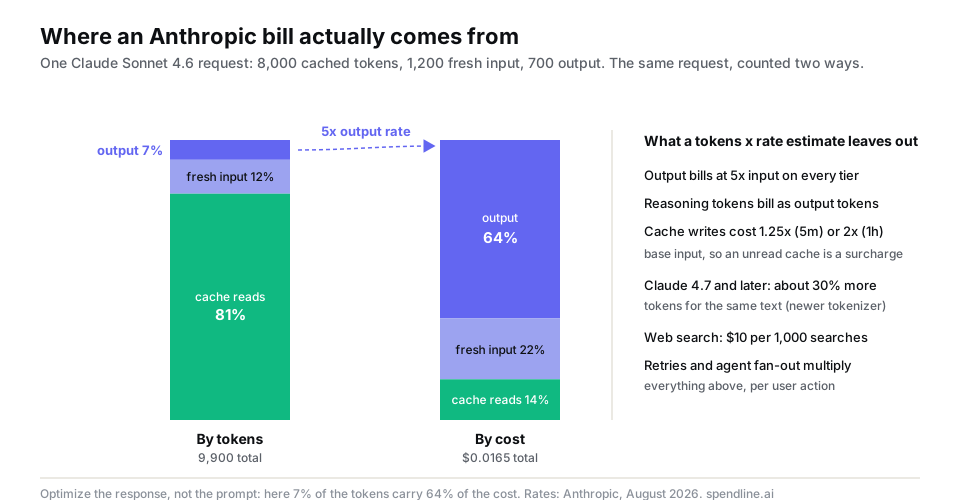
Output tokens cost 5x input, on every tier. This is the single most misread line in the rate table. Teams optimize prompt length because prompts are what they can see, while the response quietly sets the bill. In the worked example below, output is 7% of the tokens and 64% of the cost.
Reasoning tokens are billed as output tokens. Claude's thinking tokens are not a separate meter. Anthropic's documentation directs you to usage.output_tokens_details.thinking_tokens to see "how many of the billed output tokens were internal reasoning." Raise the effort level on a reasoning model and you have raised your output bill, invisibly, without changing a single prompt. On Claude Opus 4.5 and models numbered 4.6 and higher, prior turns' thinking blocks also stay in context and are billed as input.
Cache writes cost more than base input. Caching is priced as a multiplier on the base input rate: 1.25x for a five-minute write, 2x for a one-hour write, and 0.1x for a read. A cache that is written and never read is a 25% surcharge on that content. Anthropic notes the break-even directly: one read for the five-minute cache, two reads for the one-hour cache.
A model upgrade can raise cost at identical rates. Anthropic's pricing page carries a note that is easy to miss: Claude 4.7 and later models use a newer tokenizer that "produces approximately 30% more tokens for the same text." Moving from Sonnet 4.6 to a 4.7-or-later model at the same headline rate is not a flat trade. The same prompt bills more tokens.
Retries, fan-out, and server-side tools never appear in the estimate. A single agent run can fan out into hundreds of model calls, and a retry on timeout pays full input cost for a call that produced nothing. Web search is billed on top of tokens at $10 per 1,000 searches; Claude Managed Agents adds $0.08 per session-hour.
A worked monthly example
Take a support summarization workload: 400,000 requests per month, each sending an 8,000-token cached system prompt and knowledge base, 1,200 tokens of fresh input, and generating 700 output tokens. On Claude Sonnet 4.6.
Without caching, every input token bills at the $3 base rate:
9,200 input tokens  x $3  / 1M  = $0.0276
  700 output tokens x $15 / 1M  = $0.0105
                    per request = $0.0381
                x 400,000       = $15,240 / month
With the 8,000-token prefix cached and read at $0.30 per million:
8,000 cache-read tokens x $0.30 / 1M = $0.0024
1,200 fresh input       x $3    / 1M = $0.0036
  700 output            x $15   / 1M = $0.0105
                         per request = $0.0165
                     x 400,000       = $6,600 / month
Caching cuts the bill 57%. Cache writes add roughly $259 per month if the prefix is rewritten every five minutes around the clock, which barely dents the saving. Note what happens to the shape of the bill: output is now 7.1% of the tokens and 64% of the cost. Every further optimization should target the response, not the prompt.
The same request across tiers, at 400,000 per month:
| Model | Cost per request | Monthly |
|---|---|---|
| Claude Haiku 4.5 | $0.0055 | $2,200 |
| Claude Sonnet 5 | $0.0110 | $4,400 |
| Claude Opus 5 | $0.0275 | $11,000 |
The lever worth pricing in: routing the subset of traffic that does not need frontier reasoning to Haiku 4.5 is a 3x saving against Sonnet, which is larger than most prompt engineering. Note also how much of this table is outside your control. Until August 12, 2026, the Sonnet 5 row read $6,600 from September, because a 50% increase was scheduled and published. It was cancelled, and the same workload stayed at $4,400. A number that moves that far without a line of code changing is not a number to hard-code.
How to cut Anthropic API costs without losing quality
In rough order of return per hour of engineering effort:
- Cache the stable prefix. System prompts, tool definitions, and retrieved documents are usually identical across requests. Reads at 10% of base input is the largest structural discount available.
- Move the floor to a cheaper tier. Classification, extraction, and routing rarely need the top model. Tier by task, not by team preference.
- Cap output. Output is 5x input. Set
max_tokensdeliberately, ask for structured output, and tune reasoning effort rather than leaving it at the default. - Batch what is not interactive. Evals, backfills, and nightly jobs take a 50% discount on both meters through the Batch API.
- Bound the agents. Per-run step limits and retry ceilings matter more than per-call price on any agentic workload.
Note that only the first four are pricing levers. The fifth is a control problem, and it is the one that actually causes surprise invoices.
Attribution, enforcement, and the month close
Knowing the rates tells you what a call costs. It does not tell you who caused it, and it cannot stop it. Those are separate problems.
Anthropic's console reports usage by API key, workspace, and model. It has no concept of your customers, because it cannot. Per-customer cost requires tagging each request on your side of the API call with your own identifiers, the subject of our guide on tracking LLM costs per customer. Once every routed call is a priced, attributed record, cost per customer and AI gross margin follow directly.
Enforcement is the harder half. Anthropic offers organization-level usage limits, but an org-wide cap is a circuit breaker for the whole company, not a budget for one customer or one agent. A per-customer cap has to be evaluated before the request is forwarded, because once the response arrives the money is spent. This is where alerting fails as a control: a threshold alert on a runaway agent loop fires after the loop has run.
Finally, computed cost and the invoice will diverge, and finance will ask why. Common causes are stale rate tables (the cancelled Sonnet 5 increase produces exactly this in reverse: anyone who pre-loaded the September rate is now over-computing every Sonnet 5 call against the real invoice), cache tiers priced at the fresh-input rate, traffic that bypassed your metering point, retries, and the data residency multiplier of 1.1x on US-only inference. Reconciling that gap monthly and locking the period is the AI month close.
Common failure modes
- Hard-coded rates in application code. Prices change on dated schedules, and the schedules themselves change. Rate tables need effective dates and a single source of truth, or your computed costs silently drift from the bill in either direction.
- Optimizing prompts while ignoring output. The 5x multiplier means a 20% output reduction usually beats a 50% prompt reduction.
- Caching content that is never re-read. A write at 1.25x that gets one read roughly breaks even. Below that, caching costs money.
- Treating a model upgrade as rate-neutral. The 4.7-and-later tokenizer produces about 30% more tokens for the same text.
- Counting reasoning tokens as free. They are billed as output, at the output rate.
- Alerting instead of enforcing. By the time a spend alert fires, the provider has already been paid.
How Spendline does this
Spendline sits in front of the Anthropic API and does the attribution and capping this guide describes, with no SDK to install. Set the Anthropic SDK's base URL to Spendline (without /v1, the SDK adds it), keep your own Anthropic key, and add headers for customer, agent and team:
import Anthropic from "@anthropic-ai/sdk";

const client = new Anthropic({
  baseURL: "https://www.spendline.ai",              // no /v1 for the Anthropic SDK
  apiKey: process.env.ANTHROPIC_API_KEY,            // your own Anthropic key
  defaultHeaders: {
    "x-spendline-key": process.env.SPENDLINE_API_KEY,
    "x-customer-id": "acme-inc",
    "x-agent-id": "support-bot",
    "x-spendline-tags": JSON.stringify({ team: "support" }),
  },
});
Every Claude call is then priced at Anthropic's published rates, including cache reads and writes, written to an append-only ledger by customer and workflow, and checked against budgets before it is forwarded. A call that would breach a cap returns HTTP 402 and never reaches Anthropic. The same setup works for OpenAI and eight other providers, so one budget can span Claude and GPT. Full setup is on the integration page.
FAQ
How much does the Anthropic API cost? Per million tokens, as of August 2026: Haiku 4.5 at $1 input and $5 output, Sonnet 5 at $2 and $10, Sonnet 4.6 at $3 and $15, Opus 5 at $5 and $25. Cache reads are 10% of base input; the Batch API halves both meters.
Why is my Anthropic bill higher than my token estimate? Output costs 5x input, reasoning tokens bill as output, cache writes carry a premium over base input, and retries, agent fan-out, and server-side tools such as web search at $10 per 1,000 searches sit outside any per-request estimate.
Does prompt caching actually reduce Anthropic costs? Yes, when cached content is read more than written. A hit costs 10% of base input. In the example above it cut a $15,240 month to $6,600.
Is the 1M token context window more expensive per token? No. Anthropic states that Claude 4.6 and later include the full 1M context window at standard pricing. The risk is volume, not rate.
How do you cap Anthropic API spend rather than just monitor it? Organization-level limits exist in Anthropic's console, but per-customer and per-agent caps require evaluating spend against a budget before the request is forwarded.
Sources and method
All rates, multipliers, and product behavior are taken from Anthropic's pricing documentation and claude.com/pricing, verified on August 7, 2026, including the prompt caching multipliers, the Batch API discount, the 1M context window at standard pricing, the tokenizer note for Claude 4.7 and later, web search at $10 per 1,000 searches, and the 1.1x data residency multiplier. Reasoning-token billing is per Anthropic's thinking documentation. Prices change on dated schedules, so check the source before relying on any figure here. All worked calculations are our own arithmetic from those published rates and a stated hypothetical workload; they are illustrations, not measurements of any customer. The ordering of optimization levers is our judgment. Last updated: August 2026.
Want to know which of your customers your Anthropic bill is really for? Book a free 30-minute call. No integration is needed: we go through where your AI cost lands by customer and workflow, and how you would find the accounts that cost more than they pay. If the call turns up a real gap, we offer a free 60-day pilot on your own traffic. Book the 30-minute call
Not ready to talk? Take the 5-minute assessment instead.