Guide
How to Track LLM Costs Per Customer
The short answer: tag every LLM request with a customer_id set server-side, meter 100% of routed calls at a single choke point (a proxy or a wrapped client), price each request from token counts at the moment it happens, and keep the result as an append-only ledger you can roll up by customer and reconcile against the provider invoice. Each of those clauses carries weight, and skipping any one of them is how teams end up with numbers finance won't sign.
Most companies are far from this. In CloudZero's State of AI Costs research, 57% of surveyed companies still track AI costs manually in spreadsheets, and 15% have no formal cost tracking at all. LLM cost tracking at the customer level is what turns an AI bill into AI unit economics: the ability to answer "which customers are profitable?"
Why provider invoices can't show customer cost
Provider dashboards and invoices break spend down by model and API key. That view answers "what did we buy?" It cannot answer "who caused it?" And in a multi-tenant product, who caused it is the dimension that maps to revenue. Two customers on identical plans can differ by 10x in inference cost; averaged into a per-model number, both look fine. Per-customer cost allocation has to happen on your side of the API call, because only your systems know which customer a request belongs to.
The metadata contract
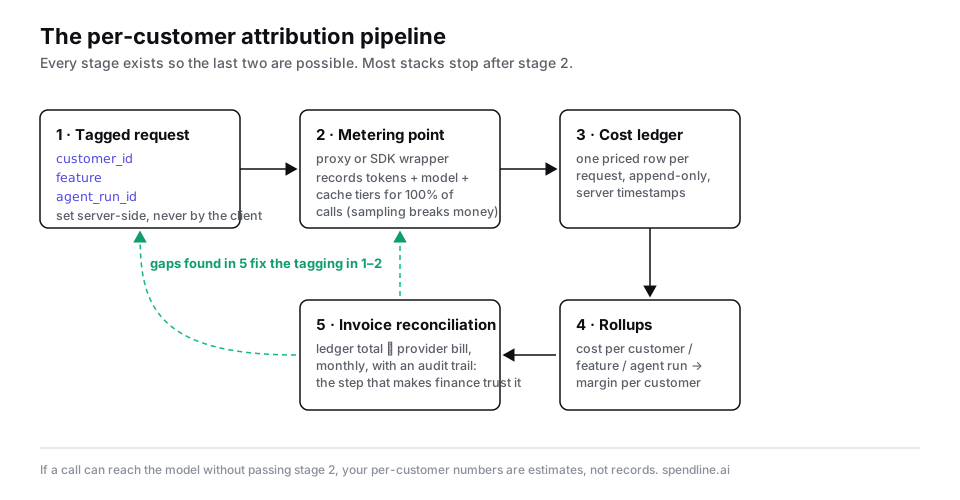
Customer-level cost attribution is a data contract, not a dashboard. Every request that reaches a model must carry, at minimum:
customer_id: the paying account (the org, not the end user). This is the join key to revenue.featureorworkflow: the product surface (chat,summarize,agent_research). Low-cardinality, safe to chart and alert on.agent_run_id: the user-initiated action that groups calls. One agent task can fan out into dozens or hundreds of model calls; without a run ID, a $4 agent run looks like 200 unrelated $0.02 requests.
Three rules make the contract hold:
- Set IDs server-side. A
customer_idaccepted from the client is a spoofable billing input. The same applies to timestamps: the server's clock decides which day and month a cost lands in, or your budget windows and month-end numbers drift. - Meter every call, not a sample. Sampling is fine for latency traces; it is wrong for money. If 5% of calls bypass the metering point, your per-customer numbers are estimates with an unknown error bar.
- Capture the token detail that pricing needs. Providers bill cached input at different rates than fresh input, and cache writes differently again. If you log only total input tokens, your computed cost will drift away from the invoice and you will discover it at month end.
What this looks like in code
With an in-path setup, the integration is a base URL swap plus the metadata headers. Using the OpenAI SDK against Spendline's endpoint:
import OpenAI from "openai";

const client = new OpenAI({
  baseURL: "https://www.spendline.ai/v1",
  apiKey: process.env.OPENAI_API_KEY,
  defaultHeaders: {
    "x-spendline-key": process.env.SPENDLINE_API_KEY,
  },
});

const response = await client.chat.completions.create(
  { model: "gpt-5.2", messages },
  {
    headers: {
      "x-customer-id": account.id,        // the paying account
      "x-workflow-id": "support_summarizer",
      "x-agent-id": agentRun.id,          // groups this run's calls
    },
  }
);
The same pattern applies with a self-hosted proxy or an SDK wrapper; what matters is that the identifiers ride with the request. Each call then lands in the ledger as one priced, attributed record:
{
  "created_at": "2026-08-04T09:12:44Z",
  "model": "claude-sonnet-4-5",
  "customer_id": "acct_4821",
  "workflow_id": "support_summarizer",
  "agent_id": "run_9f3c",
  "input_tokens": 2000,
  "cached_input_tokens": 0,
  "output_tokens": 600,
  "cost_usd": 0.015
}
And the question "what does each customer cost us?" becomes a one-liner instead of a reconstruction project:
SELECT customer_id, SUM(cost_usd) AS ai_cost
FROM ai_calls
WHERE created_at >= '2026-08-01' AND created_at < '2026-09-01'
GROUP BY customer_id
ORDER BY ai_cost DESC;
The cost math, and why rates need versioning
The full per-request calculation covers every meter the provider bills:
cost = (uncached_input_tokens × input_rate)
     + (cache_read_tokens     × cache_read_rate)
     + (cache_write_tokens    × cache_write_rate)
     + (output_tokens         × output_rate)
     + other provider-specific meters (batch, reasoning, regional)
A simplified worked example, using Claude Sonnet 4.5 list rates ($3 per million input tokens, $15 per million output, per Anthropic's published pricing) as a stable illustration rather than a current-flagship quote:
2,000 input tokens  × $3 / 1M  = $0.0060
  600 output tokens × $15 / 1M = $0.0090
                     cost/request ≈ $0.015
At 50 requests per customer per day, that's roughly $22.50 per customer per month. That is the kind of number you want per customer, from records, not divided out of an invoice. Prices change with little notice, differ per model tier, and sometimes carry introductory or regional adjustments, so the rate table itself needs a source of truth with effective dates; hard-coding prices into application code is how computed cost quietly diverges from the bill. Current per-model rates and the multipliers stacked on top of them (cache tiers, batch, reasoning tokens) are broken down in our guide to Anthropic API pricing.
Cost per customer is then the sum over the period, and gross margin per customer follows once revenue is mapped in. Mapping that revenue side correctly is its own exercise, worked end to end in how to calculate AI gross margin by customer; the wider framework and benchmarks are in our unit economics guide.
Three ways to implement it
There are three honest routes, and the right one depends on what you need the numbers for.
| DIY tagging + warehouse | Observability SDK | In-path governance proxy | |
|---|---|---|---|
| How it works | Log token counts + IDs yourself, price in SQL/dbt | Wrap your client library; platform prices each trace | Point your base URL at a proxy; it meters everything routed through it |
| Coverage | Only what you remember to instrument | Only code using the wrapper | Every routed call, by construction |
| Engineering effort | Highest, ongoing | Low per service, per-codebase | Base URL change, plus metadata injection for full attribution |
| Can it enforce (block/cap)? | No | Generally no; it observes | Yes; budgets evaluated before each request is forwarded |
| Finance-ready (reconciliation, immutable ledger) | If you build it | Rarely the focus | The point of the category |
Tools like Langfuse and Braintrust are strong in the observability lane: they exist primarily to debug, trace, and evaluate LLM behavior, with cost as one attribute of a trace (the alternatives in that lane, and where they stop, are compared in Langfuse alternatives). LiteLLM is a popular open-source proxy with spend tracking if you want to run the in-path route yourself. A governance proxy like Spendline is the managed version of that third route, adding the parts finance asks for: budget enforcement before the provider call, an append-only ledger, and a month-close workflow. (Where each layer stops is mapped in gateway vs. observability vs. governance.)
The practical test: if a call can reach the model without passing your metering point, you have monitoring, not accounting.
From tracking to control and close
Attribution is the foundation, not the finish line. Once every request is a priced, attributed record, two things become possible that aren't otherwise:
- Enforcement. Budgets per customer, team, or agent that block or reroute before the request is forwarded, instead of alerting after the spend happened. A runaway agent loop is an in-flight problem; a weekly cost review cannot catch it in time, and the controls that stop a single run work on the run ID rather than the month. The scopes, the actions available when a cap is hit, and the concurrency trap are covered in LLM budget enforcement.
- The finance loop. Monthly reconciliation of your ledger total against the provider invoice, investigation of any gap, and a close that locks the period. A persistent reconciliation gap usually points to incomplete token-type capture, stale rate tables, side-door traffic, retries, or provider-specific pricing adjustments. The workflow is described in The AI month close, and the invoice comparison itself is worked line by line in how to reconcile OpenAI and Anthropic invoices.
Common failure modes
- Client-supplied attribution. IDs or timestamps trusted from the browser/SDK caller: spoofable, and they corrupt budget windows.
- The side-door path. A batch job, cron script, or new microservice calls the provider directly and never appears in your numbers. (This is the strongest argument for metering at the network path rather than in code.)
- Cached tokens priced wrong. One common cause of invoice divergence is cache reads and writes being priced at the fresh-input rate, or not captured as separate fields at all.
- Agent fan-out without a run ID. Per-request numbers look healthy while a single user action quietly costs dollars.
- Mutable records. If cost rows can be edited in place, reconciliation can't prove anything; corrections should be new rows.
How Spendline does this
Spendline is the managed in-path route from this guide. Point your provider base URL at Spendline, send x-customer-id (and optionally x-agent-id and x-spendline-tags for team or cost centre) on every request, and each call is priced at the moment it happens and written to an append-only ledger attributed to that customer. One ledger covers OpenAI, Anthropic and eight other providers, so cost per customer is comparable across models. Load revenue per customer and Spendline reports the margin left after AI cost on each account, and when the month ends the same ledger is what gets reconciled against the provider invoice.
The code sample earlier in this guide is a complete integration. If you already tag calls with your own customer identifiers, they map straight onto the x-customer-id header with no SDK to install. Details are on the integration page.
FAQ
Can OpenAI or Anthropic show cost per customer? No. Provider dashboards break spend down by API key, project, and model; they have no concept of your customers. Customer-level attribution has to happen on your side of the API call, via request tagging.
What metadata should every LLM request contain?
A customer_id, a feature or workflow name, and an agent run ID, all set server-side. That trio supports per-customer cost, per-feature economics, and per-run agent accounting.
Do you need an LLM proxy to track costs accurately? Not strictly. Wrappers and DIY logging work if every call path uses them. A proxy guarantees coverage by construction, and it is the only route that can also enforce budgets before a request reaches the provider.
How should cached tokens be priced? At the provider's cache rates: on Anthropic models, cache reads run about a tenth of the base input price and cache writes carry a premium. Log cached and fresh counts separately.
How do you reconcile calculated LLM costs with provider invoices? Sum the ledger by provider for the billing period, compare to each invoice, investigate persistent gaps (token-type capture, stale rates, side-door traffic, retries, pricing adjustments), post corrections as new records, and lock the period.
Sources and method
Written from building and testing Spendline's AI spend governance proxy, combined with public sources: adoption figures from CloudZero's State of AI Costs research; model pricing from Anthropic's published price list (illustrative rates; check current prices before relying on them); tool descriptions from each vendor's public documentation. The three-route comparison is our categorization judgment. Last updated: August 2026.
Want to see cost per customer for your product before building any of this? Book a free 30-minute call. No integration is needed: we go through where your AI cost lands by customer and workflow, and how you would find the accounts that cost more than they pay. If the call turns up a real gap, we offer a free 60-day pilot on your own traffic. Book the 30-minute call
Not ready to talk? Take the 5-minute assessment instead.