Guide
LLM Budget Enforcement: Alerts, Approvals, and Hard Caps
The short answer: an LLM budget is only enforced if a request can be refused before it reaches the provider. Everything else (dashboards, weekly cost reviews, alerts at 80% and 90%) is reporting on money that is already spent. Real enforcement means evaluating the projected cost of a request against the remaining budget for its scope, at the moment of the request, and taking one of four actions: allow, reroute to a cheaper model, require an approval, or refuse. This guide covers the hierarchy those budgets live in, what each action should do, and the concurrency problem that quietly breaks most first implementations.
Managing AI spend is now near-universal as a practice. In the State of FinOps 2026 report, 98% of 1,192 surveyed practitioners said they manage AI spend, up from 31% two years earlier. Managing it and being able to stop it are different things.
Why alerting is a postmortem
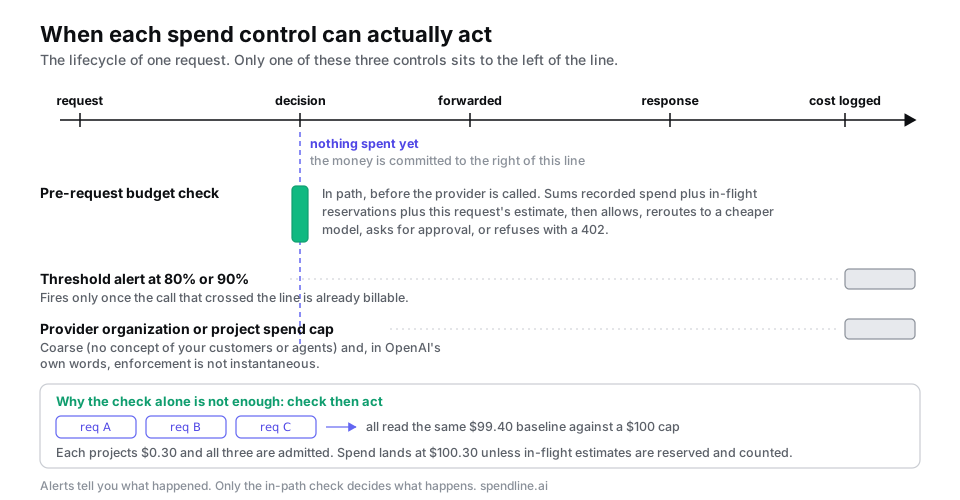
An alert at 80% of budget tells you that a call already happened, was already priced, and is already on the invoice. The gap between "we noticed" and "we can act" is where the money goes, and with agents that gap is brutal. A retry loop or a fan-out step does not spend a monthly budget over a month. It spends it in the twenty minutes between the alert firing and someone reading it. The specific ways a single run runs away, and the per-run controls that stop it, are covered in how to stop runaway AI agent spend.
Provider-side caps help, and you should turn them on, but they stop short of what a multi-tenant product needs on two counts.
The first is granularity. OpenAI's spend limits can be set on the organization or on a project, and hitting one returns a 429 with organization_spend_limit_exceeded or project_spend_limit_exceeded. Anthropic's workspaces each carry a monthly spend cap and alert thresholds, configured in the Console. Both are real controls. Neither knows what a customer is. If one enterprise account's agent goes into a loop, an org-level cap either sits far too high to catch it or trips and takes down every other customer's traffic with it.
The second is timing. OpenAI's own documentation is explicit that "enforcement is not instantaneous, so recorded spend can slightly exceed the configured amount." That is a reasonable engineering tradeoff for a provider operating at their scale. It is not a property you want your customer-level margin to depend on.
The scope hierarchy
A single monthly number is not a budget system. Spend has to be capped at the level where the decision means something, and one request usually falls under several caps at once. The four scopes that matter, evaluated most specific first:
| Scope | The question it answers | Typical action on breach |
|---|---|---|
agent |
Has this one agent or job run away? | Block. A looping agent is a bug, not a business decision. |
customer |
Is this account consuming more than its plan supports? | Reroute or require approval. Blocking a paying customer is a commercial decision. |
team |
Is a department inside the company over its allocation? | Require approval, so a human owns the overrun. |
org |
Is total company AI spend over plan? | Block, as the last line of defence. |
Evaluation order matters. Checking the most specific scope first means the block you return names the cap that actually stopped the request, which is the difference between a useful error and a support ticket. Every scope needs both a limit and a mode: strict scopes enforce, advisory scopes only record what they would have done. Shipping every new budget in advisory mode first, reading a week of logs, and only then flipping it to strict is the difference between a rollout and an outage.
Scope only works if the attribution underneath it is trustworthy, which means the identifiers are set server side and never accepted from the caller. That contract is covered in how to track LLM costs per customer.
What the check looks like
With an in-path proxy, the client integration is a base URL change plus metadata injection for full attribution:
const response = await client.chat.completions.create(
  { model: "gpt-5.2", messages, max_tokens: 800 },
  {
    headers: {
      "x-customer-id": account.id,     // which cap applies
      "x-agent-id": agentRun.id,       // which run to hold accountable
      "x-workflow-id": "support_summarizer",
    },
  }
);
The budget itself is a record, not code:
{
  "scope_type": "customer",
  "scope_id": "acct_4821",
  "monthly_limit_usd": 100.00,
  "strict_mode": true,
  "require_approval_on_exceed": false
}
And a refusal is an ordinary HTTP response your client can handle, returned with status 402 before any provider call is made:
{
  "error": {
    "type": "budget_exceeded",
    "message": "Request rejected: projected spend ($100.30) would exceed customer budget ($100.00).",
    "scope_type": "customer",
    "scope_id": "acct_4821",
    "monthly_limit": 100.00,
    "current_spend": 99.40,
    "estimated_request_cost": 0.30,
    "projected_spend": 100.30
  }
}
Returning the numbers in the error body is not decoration. It is what lets the calling application degrade intelligently (fall back to a cheaper model, queue the job, show the customer an upgrade path) instead of surfacing a generic failure.
The two problems that break naive implementations
1. The estimate under-counts
You cannot know how long the response will be before you get it, so a pre-call estimate has to project the output. The tempting shortcut is to price the input tokens and move on. That guarantees under-counting, because output is the more expensive meter on every major model tier (five times input on the current Claude tiers, per Anthropic's published pricing), and reasoning tokens are billed as output too.
The safe rule is to project output pessimistically: take the caller's requested cap (max_tokens or max_completion_tokens) as the upper bound, and apply a sensible default floor when no cap is given. An estimate that is too high costs you a small amount of headroom at the very edge of a budget. An estimate that is too low is a budget that does not hold.
2. The check-then-act race
This is the one that gets skipped. A budget check reads recorded spend, compares it to the cap, and admits the request. But the cost of that request is not recorded until the response completes, which can be many seconds later. In the meantime every other concurrent request reads the same stale baseline.
At $99.40 of $100 spent, ten simultaneous calls each projecting $0.30 all see room and all pass. You end the minute at $102.40 on a $100 cap, with every individual decision technically correct.
The fix is a reservation. On admission, the estimated cost is held against every scope the request falls under, and the next check counts recorded spend plus outstanding reservations plus the new estimate. When the response completes and the real cost lands in the ledger, the reservation is released. Two details make or break it: reservations have to be keyed to the account rather than the individual API key (or minting a second key evades the cap), and the release has to happen on the error and client-disconnect paths too, or a stream of failed requests slowly strangles a healthy budget with phantom holds.
What happens when a cap is hit
| Action | When it fits | What the caller sees |
|---|---|---|
| Block | Hard financial ceilings, runaway agents, closed months | 402 with the scope and the numbers, no provider call |
| Reroute | Quality can degrade but service should not stop | A normal response from a cheaper model, recorded as rerouted |
| Require approval | A human should own the overrun (team and customer scopes) | A pending state, then a bounded, expiring override once approved |
| Advisory | Any new budget, for its first week | Nothing. The block is recorded, not applied |
Reroute deserves a note, because the ordering is subtle. If a cheaper model is chosen only after the budget check has already refused the request, rerouting can never rescue a blocked call. Resolving the reroute first, then checking the budget against the cheaper model's price, means a downgrade can cure a block instead of arriving too late to matter. The same applies to approvals: an override has to be scoped to the budget it was approved for and to expire on its own, or one emergency approval quietly becomes a permanent cap increase nobody remembers granting.
How this connects to attribution and close
Enforcement is the middle link in a chain. Attribution decides which cap applies to a request. Enforcement decides whether the request happens. The month close proves both were right: the ledger totals are reconciled against the provider invoice, the period is locked, and any correction is posted as a new record rather than an edit.
That last part matters for enforcement specifically. A blocked request is a financial event and belongs in the audit trail alongside the calls that succeeded. When someone asks in November why a customer's spend flattened in August, "the customer scope cap held, here are the 412 refusals" is an answer. Silence is not. The margin arithmetic those numbers eventually feed is in the LLM unit economics guide, and where enforcement sits relative to gateways and tracing platforms is mapped in gateway vs observability vs governance.
Common failure modes
- Alert thresholds mistaken for caps. An 80% notification changes nothing about whether the next call goes through.
- The estimate ignores output tokens. The cheaper half of the bill is enforced and the expensive half is not.
- No reservation for in-flight spend. Concurrency turns a hard cap into a suggestion.
- A new API key escapes the cap. Budgets keyed to a single key rather than to the account are trivially bypassed, usually by accident.
- Client-supplied timestamps deciding the window. If the caller's clock decides which month a call lands in, the caller decides which budget it counts against.
- Overrides with no expiry. The emergency raise that never gets lowered.
- Straight to strict mode. A budget with a wrong limit or wrong scope, enforced on day one, is an outage.
How Spendline does this
Spendline is a hosted AI spend governance proxy that enforces the hierarchy described above, in the request path, before the provider is called. You point the OpenAI or Anthropic SDK at Spendline's base URL and keep your own provider key; Spendline prices the request, checks it against every budget in scope (org, team, agent, customer), and either forwards it, reroutes it to a cheaper model, or refuses it with HTTP 402 so no spend occurs. Budgets span providers because the check happens in one place for all ten supported providers.
import OpenAI from "openai";

const client = new OpenAI({
  baseURL: "https://www.spendline.ai/v1",          // with /v1 for the OpenAI SDK
  apiKey: process.env.OPENAI_API_KEY,               // your own provider key
  defaultHeaders: {
    "x-spendline-key": process.env.SPENDLINE_API_KEY,
    "x-customer-id": "acme-inc",
    "x-agent-id": "support-bot",
    "x-spendline-tags": JSON.stringify({ team: "support", env: "prod" }),
  },
});
A blocked call is recorded in the same append-only ledger as the calls that succeeded, so the refusals are in the audit trail when finance asks. Budgets start in monitor mode and are switched to enforce once the limits and scopes are proven, which is the "straight to strict mode" failure above avoided by default. Setup and the full header reference are on the integration page.
FAQ
What is the difference between an LLM spend alert and LLM budget enforcement? An alert reports a cost that is already billable. Enforcement is a decision taken before the request is forwarded: allow, reroute, require approval, or refuse. Only the second one can change an outcome.
Can OpenAI or Anthropic enforce a budget per customer or per agent? No. OpenAI offers hard spend limits at the organization and project level, and states that enforcement is not instantaneous. Anthropic offers monthly spend caps per workspace. Neither has a concept of your customers, because only your systems know which request belongs to whom.
What should happen when an LLM budget cap is hit? Block, reroute to a cheaper model, require a bounded and expiring approval, or record the would-be block in advisory mode. The right choice differs by scope: block a looping agent, but treat blocking a paying customer as a commercial decision.
Why do concurrent requests break naive budget checks? Check then act. Simultaneous requests all read the same spend baseline before any of them has logged a cost, so they are all admitted. Reserve each admitted estimate and count outstanding reservations in the next check.
How do you estimate a request's cost before the model has responded?
Project the output pessimistically using the caller's max_tokens cap, with a default floor when none is given. Counting input tokens only under-counts every request, because output is the more expensive meter.
Sources and method
Written from building and operating Spendline's AI spend governance proxy. Provider capabilities verified on 11 August 2026 against primary documentation: OpenAI spend limits for the organization and project scopes, the 429 error codes, and the statement that enforcement is not instantaneous; Anthropic workspaces for per-workspace monthly spend caps and alert thresholds. Adoption figures from the State of FinOps 2026 report (1,192 respondents). The four-scope hierarchy, the action table, and the reservation pattern are our design and engineering judgment, not an industry standard. Last updated: August 2026.
Want to know which customer or workflow would hit a cap first? Book a free 30-minute call. No integration is needed: we go through where your AI cost lands by customer and workflow, and how you would find the accounts that cost more than they pay. If the call turns up a real gap, we offer a free 60-day pilot on your own traffic. Book the 30-minute call
Not ready to talk? Take the 5-minute assessment instead.